A UNIVERSE
Beam Camp, Strafford, NH, 2021


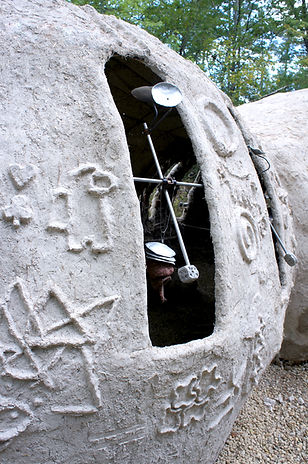
According to Taoists the universe is bottle gourd shaped, resembling the number 8 (the mobius strip; infinity). The conjoined double domes of “A Universe” are soft in their roundness with a thick wall made of cob and lime plaster. The density of the wall retains the tranquility inside, while its resonant quality carries the sound of wind blowing through the arch openings like a pipe. Flanking the two openings are eight vertical windows on each side, illuminating the interior with stripes of light. On each window is an instrument that is activated by catching rainwater. Rain falling on the gourd will collect in grooved passages and will be directed into the cups of the instruments, moving them by the gravity of accumulating water like kinetic fountains. When the cups fill up, tip and spill, a new note of a chime, drum, or string accords with all the sounds around. At times the space is conducive to meditation in its serenity, but if the weather permits, the gourd comes alive as a giant instrument played by chance and nature.
The shape of a bottle gourd is body-like, its belly has been used by cultures around the world to make dolls resembling human and animal figures. “A Universe,” however, is a giant gourd body with its limbs on the inside. On the floor and against the walls of the domes are two hands and two feet, they cup a little and are large enough to be seats. Multi-faced heads hang at the apex of the two vaults like chandeliers. The circularity of the many faces suggests a way of perceiving that is not facing one direction but all directions, outwards and in. The head, hands, and feet are extremities of the body that help us navigate our environments. But what happens when our senses are turned inwards? How do we cultivate the skills to navigate our internal landscapes? Like the instruments sitting on the windows, between inside and out, the gourd’s inverted body asks its visitors to look at one’s own body as an instrument that resonates inwards and out. The permeability of the senses reminds us that our bodies are not merely mechanical and material consequences of evolution and politics. Our bodies are sites for perceiving the universe, and the perceiver, each of us, is a universe. There is an exchange and interdependence between our interior and exterior states, collectively.
On the outside surface of “A Universe,” campers will tell their own stories on the wall by making ceramic and plaster reliefs, and perhaps, fresco paintings. To recall the past, investigate the present, and write into the future is an empowering exercise of giving form to these hidden and crucial aspects of ourselves. On the skin of the gourd body, we see fashion, paint, jewelry, scars, ornaments—our collective voices emanating a symphony (or cacophony) of chance and invention. When we step into the gourd, we are reminded to step into ourselves, to inhabit ourselves respectfully and purposefully. Perhaps, the more conscious we are of how connected our internal being is in relation to our external environment, we may begin to develop this sensitivity and apply it to how we imagine and inhabit our outside worlds. Even when the rain is not falling and there’s no music in the air, the potential of what can happen in this space changes the totality of how we experience it in the present. “A Universe” speaks to the poetics of space (delineated by an inside and outside—what is an instrument?), is a meditation on embodiment (what does it mean to invert our internal and external relations?), and invokes the freedom of music to permeate (walls, bodies, minds, time).